Að móta eigin framtíð
Í gær flutti ég erindi á árlegum fundi forseta þjóðþinga Norðurlanda og Eystrasaltsríkja, NB8, sem haldinn var í Smiðju Alþingis í Reykjavík.
Í erindinu fjallaði ég um hvernig við getum fært lýðræðislega aðkomu að þróun og innleiðingu gervigreindar framar í ferlið og hvernig Norðurlöndin og Eystrasaltsríkin geta sameinast um að móta tæknina í samræmi við eigin gildi og samfélagsleg markmið.
Ég deili erindinu og glærum hér fyrir neðan.

Who decided how our public squares should work?
It wasn’t parliaments that decided our public square should be governed by algorithms designed to maximize advertising revenue.
It wasn’t citizens who decided that children should grow up inside systems designed to capture their attention.
Yet those choices were made. Not by us. But through product design, shaped by business models, driven by commercial incentives. And by the time we understood their consequences, the platforms were already embedded in our everyday lives.
When we look back at the social media era, the obvious lesson is that governments should have regulated faster. But I think there is a deeper lesson.
Once a technology becomes infrastructure, the choices built into it become the rules we all live by, even though nobody decided democratically that those should be the rules.
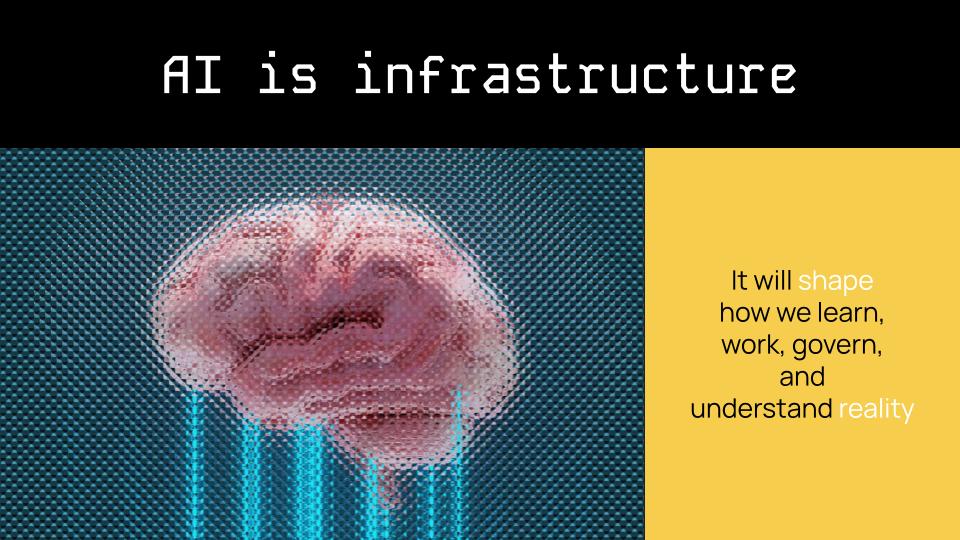
And now we stand at another pivotal moment, where generative AI is rapidly becoming infrastructure.
Whilst the earlier generation of social media algorithms selected and ranked existing content, generative AI adds something fundamentally different. It can create the content. It can create the story, the argument, the image, the advice.
And increasingly these systems are becoming part of how we learn, how we think and work, how public institutions operate and how we understand the world.
So before that infrastructure hardens around us, we should ask a question while there is still time to do something with the answer:
Where are the decisions about what these systems become and how they are used, actually being made?
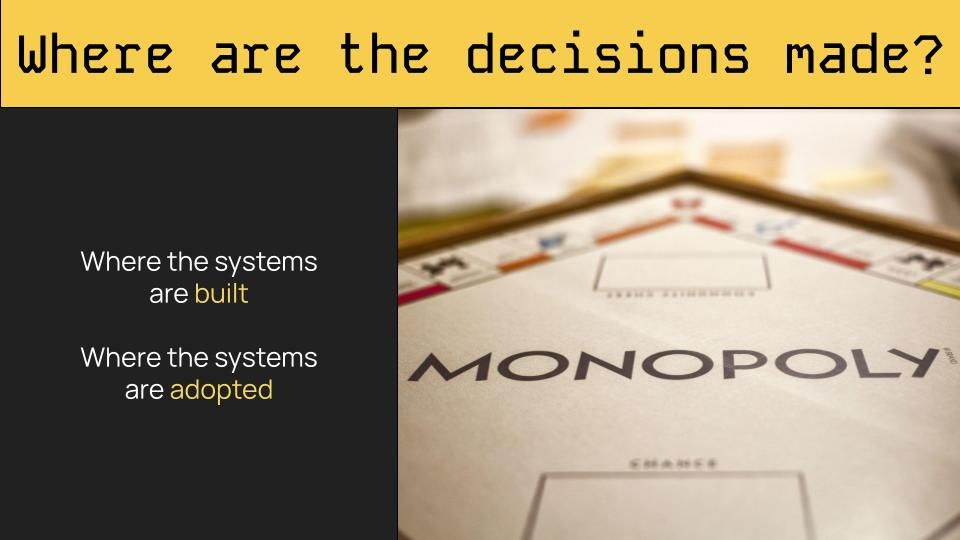
There are at least two places we need to look. The first is upstream, where the systems themselves are being built. These decisions are being made largely inside the companies developing the models.
In choices about what data they learn from, what they are optimized to do, what powers they are given, and what they are allowed to remember about us.
These may look like technical choices. But they are also decisions about values.
Because a system optimized for productivity will make different tradeoffs from one designed to strengthen human judgment. A system built to maximize market share will develop differently from one built as public infrastructure.
And then there is a second set of decisions, made much closer to home.
When a ministry chooses an AI provider or a municipality buys a digital platform. These decisions are usually treated as procurement decisions. But choosing a system also means choosing its architecture, its dependencies, its data flows, and its limits.
Once thousands of public employees have been trained on a platform, government data has been structured around it, services have been connected to it and institutions depend on it every day, leaving becomes increasingly difficult and expensive.
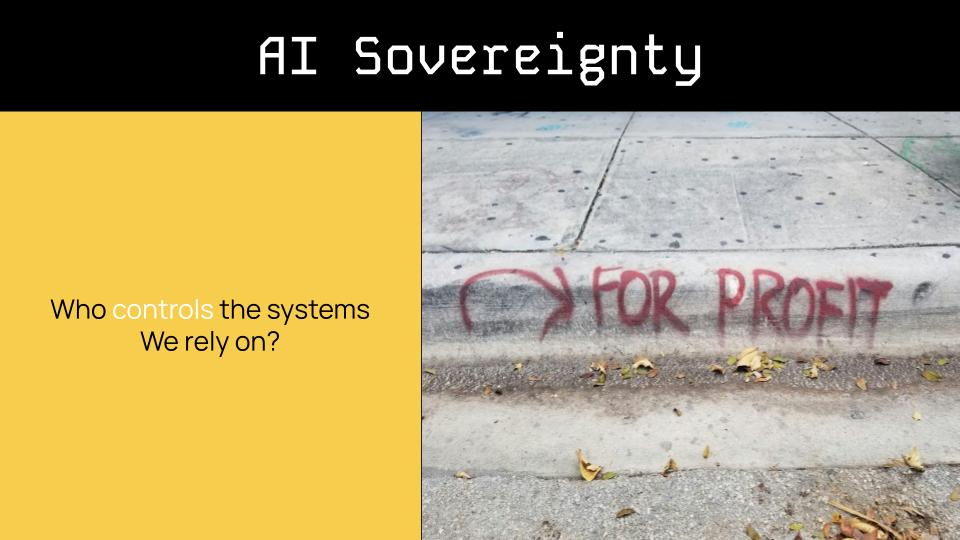
This is why sovereignty in the age of AI is about much more than where our data is stored. It is about whether democratic institutions retain meaningful power over the systems through which they increasingly operate.
We don’t need to assume bad intentions to see the problem (although the current state of the world certainly gives us reason to).
At the end of the day, companies are doing what companies are designed to do. They compete, grow, increase productivity and seek returns on enormous investments.
Democracies have a different job. They protect rights, distribute power, preserve trust, and educate citizens. They support human wellbeing and to do that they have to think beyond the next quarter.
The problem begins when systems built to serve the first set of objectives, the for profit objectives, become infrastructure for institutions responsible for the second set, the democratic objectives. At that point, a mismatch of incentives becomes a question of democratic power.
And increasingly we are handing that power over to private industry.
And the importance of retaining democratic power becomes even greater as the systems themselves are given greater power to act.
Enter the next generation of AI, which is agentic.
AI agents mean we are no longer only asking a system for information, or giving it a specific instruction, we are giving it a goal and allowing it to decide how to achieve it.
Think about what that means inside public institutions.
And keep in mind that these systems cannot reliably explain how they arrived at a particular judgment. They can generate a plausible justification, but they are incapable of verifying their own output. This is not a programming flaw, it is architectural.
The usual reassurance is that a human remains in the loop. But simply placing a human somewhere in the process doesn’t mean the human is meaningfully in control.
To exercise real oversight, a person needs to understand enough about what the system can and can’t do. They need to be able to see what it’s doing. They need the authority to constrain it. And they need the ability to intervene before a mistake becomes consequential.
Knowledge. Observation. Control. Intervention.
Without those conditions, human oversight is little more than an approval button, a rubber stamp.
And the better the system becomes, the easier it becomes to simply trust it. If it produces reasonable recommendations day after day, checking every decision starts to feel unnecessary. Until the day it matters.
So the question can’t simply be whether there is a human in the loop. The question is whether the human still has meaningful power over the decision.
And meaningful power requires something we rarely celebrate in discussions about technology. Friction.
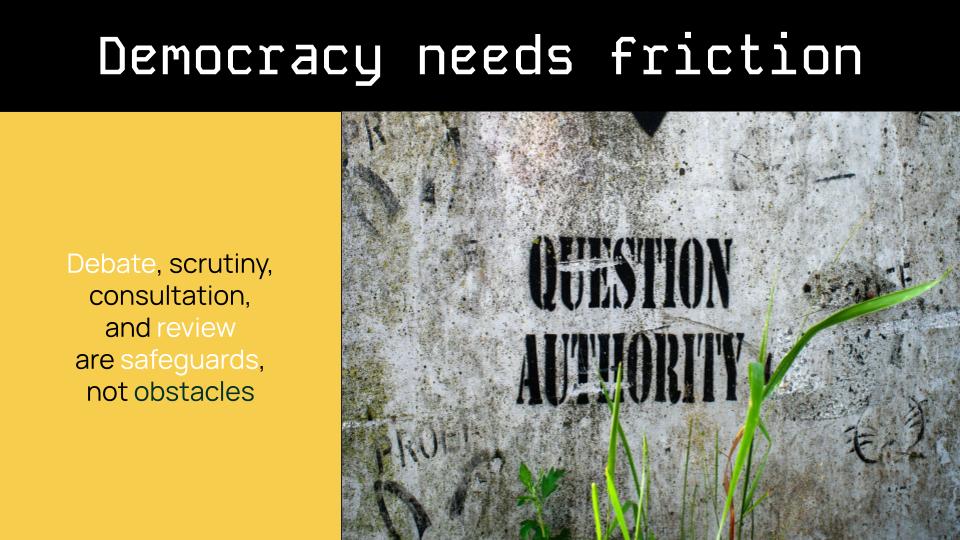
We usually talk about friction as something technology should remove.
Fewer steps. Faster decisions. Less waiting. Less human involvement. And in many places, removing friction is genuinely useful. But some friction exists for a reason and democracy is full of it.
Debate, opposition, consultation, scientific scrutiny, judicial review. This is all friction, processes that slow decisions down. But they serve an important purpose.
They create space to test the evidence, expose assumptions, hear the people affected, protect rights that efficiency might overlook and consider consequences that may not appear for years.
To dissolve that friction so technology can move at the pace the market sets is to abandon what democracies were created to do. To make sure we can deliberate and think together, mark a common course, and evolve toward a better future.
The challenge for parliaments, government and public institutions, then, is not to move at the speed of the technology. It is to make sure democratic judgment is introduced early enough that the speed of AI development and adoption does not decide the future for us.
So the task is to move democratic attention upstream, to the point where the options are still open.
And we don’t have to start from scratch. Much of the knowledge of how to do this already exists across our region.

The are three important capacities I would like to point out, the first being the capacity to see choices coming.
Future committees are one way of creating a permanent institutional home for that work inside parliaments.
Finland has shown how foresight can be built directly into parliamentary and government decision making. Estonia and Lithuania have also developed strong foresight capacity, helping governments and legislators examine emerging changes before they arrive as crises.
Estonia shows something else as well: how foresight can be connected to experimentation, allowing the state to test ideas early, learn from evidence and scale what works.
The second capacity is the capacity to make better choices about the technologies we adopt.
Norway has built independent technology assessment into political decision making, combining technological expertise with citizen deliberation.
Denmark is showing what digital sovereignty can look like in practice, actively exploring alternatives to dominant technology providers and investing in greater technological independence.
Sweden is pursuing the same goal through strategic procurement and cloud policy that reduces dependence and preserves the freedom to change providers.

And then there is a third capacity. The capacity to create choices that the market may never offer us.
Latvia’s parliament has passed legislation creating public capacity for AI development and governance, connecting government, research and industry with an explicit mandate to ensure that the Latvian language is represented in AI models.
And in Iceland, we have treated our language as something technology should adapt to, rather than something we should sacrifice to the technological default.
We invested collectively in open language infrastructure because we had already made a democratic judgment about what mattered. That Icelandic should have a future in the digital world.
These are all different approaches, but they answer the same underlying question:
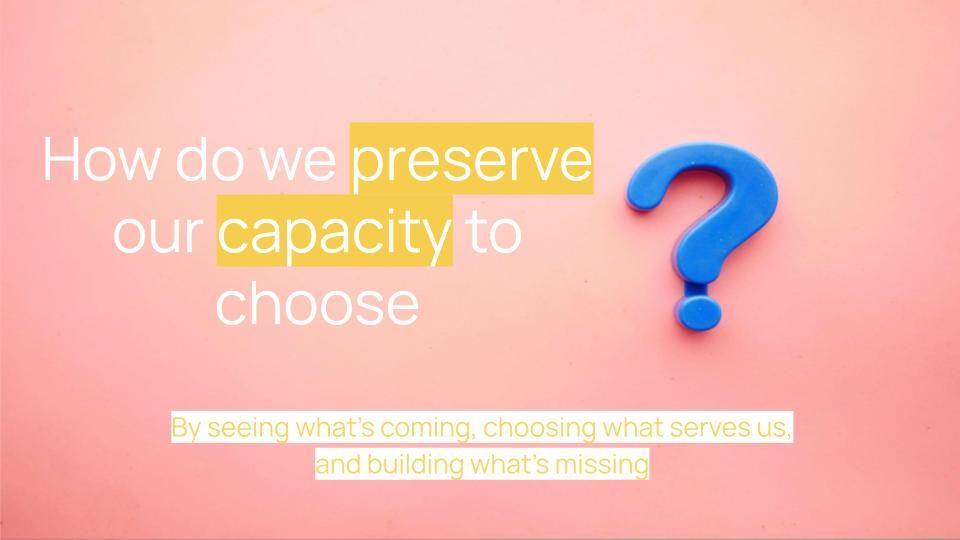
How do we preserve the capacity to choose?
We need the foresight to see what is coming, the judgment to choose what serves us, and the capacity to build what is missing.
That last part matters.
Because foresight and better procurement can help us choose more wisely among the systems that exist. But if the available systems are all built around objectives and architectures that do not serve our societies well, then choosing among them is not enough.
We also need alternatives.
When the global market had little commercial reason to build the technological infrastructure Icelandic needed to survive, we didn’t simply accept the available options. We invested collectively in building something different.
The same principle can apply more broadly to AI.
Not by trying to reproduce Silicon Valley at Nordic and Baltic scale. That’s never going to work.
But by investing in technological paths, public infrastructure and research that reflect the things our societies have decided are worth protecting.
And it is worth noting that the architecture of current AI is not the only future for AI. Other approaches exist, AI that gives explainable results. Runs on small data. Learns from experience. Fits on a laptop. Runs on domestic hardware, with domestic data storage, under national law.
But such systems are unlikely to be developed by a market that has already committed to a different path. If we want them, we will have to build them.
And this is where cooperation becomes powerful.
Because none of us individually will determine the direction of the global AI industry. But together, we can increase our ability to understand it, challenge it, influence it and build alternatives to it.
We can share parliamentary expertise and foresight capacity. We can develop common principles for public technology procurement. We can build shared digital infrastructure that gives our institutions genuine alternatives to dependence on a handful of global companies. We can fund new research, support alternative paradigm AI.
And we can create democratic forums for the questions that private interests should not be answering for us.
Questions like:
What should education look like when machines can produce answers instantly?
How should the gains from automation be distributed?
Which parts of our common infrastructure do we refuse to surrender to systems we cannot inspect, modify or leave?
These are not technical questions. They are questions about what kind of societies we want to become. And they belong to all of us.
I began by asking who decided how our public squares should work. We were late to that decision.
But when it comes to generative AI, many of the choices are still open. We can still decide which judgments we delegate, which infrastructure we depend on, which technological paths we invest in.
And we can decide that a functioning democratic society is more important than winning a race whose rules and destination were set somewhere else by interests that don’t align with ours.
I think this is not just our duty, but the successful route to a future in which technological progress and human flourishing actually reinforce one another.